Blog
Custom Glass Bottle Manufacturing in Ningbo, China

Costs, MOQ, Mold Fees, Production Timeline and Quality Control Explained
Sourcing custom glass bottles from Ningbo, China can be highly profitable — especially for premium spirits, cosmetics and beverage brands.
However, custom bottle manufacturing is not a simple transactional purchase. It is an engineered process involving:
- Technical artwork precision
- Mold development
- Sample revision cycles
- Strict dimensional tolerance
- Structured quality control
In this guide, we explain the real 2026 costs, realistic MOQs, timelines, and the most common mistakes importers make when manufacturing custom glass bottles in China.
Why Ningbo for Custom Glass Bottles?
Ningbo is one of China’s main hubs for:
- Spirit bottles
- Cosmetic glass packaging
- Beverage containers
- Custom heavy glass molds
Advantages include:
- Specialized mold engineering ecosystem
- Competitive production costs
- Strong port infrastructure
- Skilled decoration factories (screen printing, frosting, hot stamping)
However, production capability varies significantly between factories. Proper technical coordination is essential.
Step 1 – Artwork Preparation (Critical Phase)
Most production delays begin during artwork development.
Technical Requirements
Factories require:
- AI (Adobe Illustrator vector)
- CDR (CorelDraw)
- Vector PDF
Raster files (JPG/PNG) are not suitable for production.
Common Technical Errors
- Pantone color mismatch on glass surface
- Lines thinner than 0.2 mm
- Relief depth not clearly defined
- No positioning tolerance for curved surfaces
- Missing wall thickness specification
Realistic Artwork Timeline
- Initial review: 3–5 days
- Technical adjustment: 3–7 days
- Final confirmation: 2–3 days
Average: 7–15 days
Step 2 – Mold Development
Custom bottle shapes require dedicated molds.
Typical Mold Investment (2026 Range)
- Standard spirit bottle: USD 3,000–6,000
- Heavy premium bottle: USD 5,000–10,000+
Mold Development Timeline
- Engineering drawing approval: 5–7 days
- Mold manufacturing: 15–25 days
- First test sample: 5–7 days
Total: 25–40 days
Critical mistake to avoid:
Approving mold drawings without verifying dimensional tolerances and neck finishing details.
Step 3 – Sampling & Revision
Sampling ensures:
- Design consistency
- Weight accuracy
- Structural balance
- Print alignment
Typical sampling time:
7–12 days per cycle.
Without local coordination, revision cycles often double.
Step 4 – Mass Production Timeline
Once samples are approved:
| Phase | Estimated Time |
| Raw material preparation | 3–5 days |
| Glass forming production | 10–20 days |
| Surface decoration | 7–15 days |
| Final inspection & packing | 3–5 days |
Average total production time:
30–45 days.
MOQ (Minimum Order Quantity)
Typical MOQs:
- Existing mold: 10,000–30,000 pcs
- New custom mold: 30,000–50,000 pcs
- Heavy decorative glass: higher depending on mold cavity
MOQ depends on weight, mold structure and decoration complexity.
Quality Control – Where Premium Projects Succeed or Fail
Common quality risks:
- Wall thickness variation
- Micro bubbles
- Surface scratches
- Print durability issues
- Color density inconsistency
Professional QC should include:
- Dimensional measurement
- Weight variance check
- Print adhesion test
- Batch consistency review
- Random sampling during production
Quality control must be performed:
- During production
- Before packing
- Not only at final stage
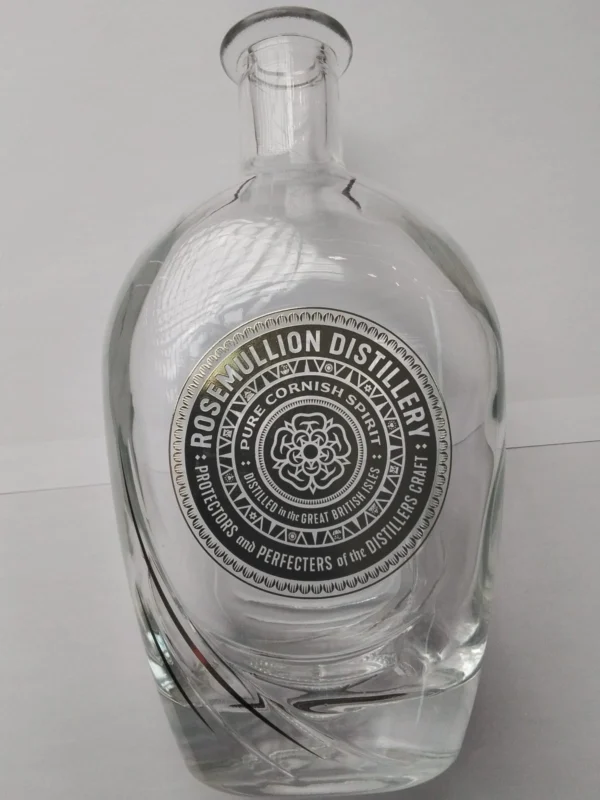
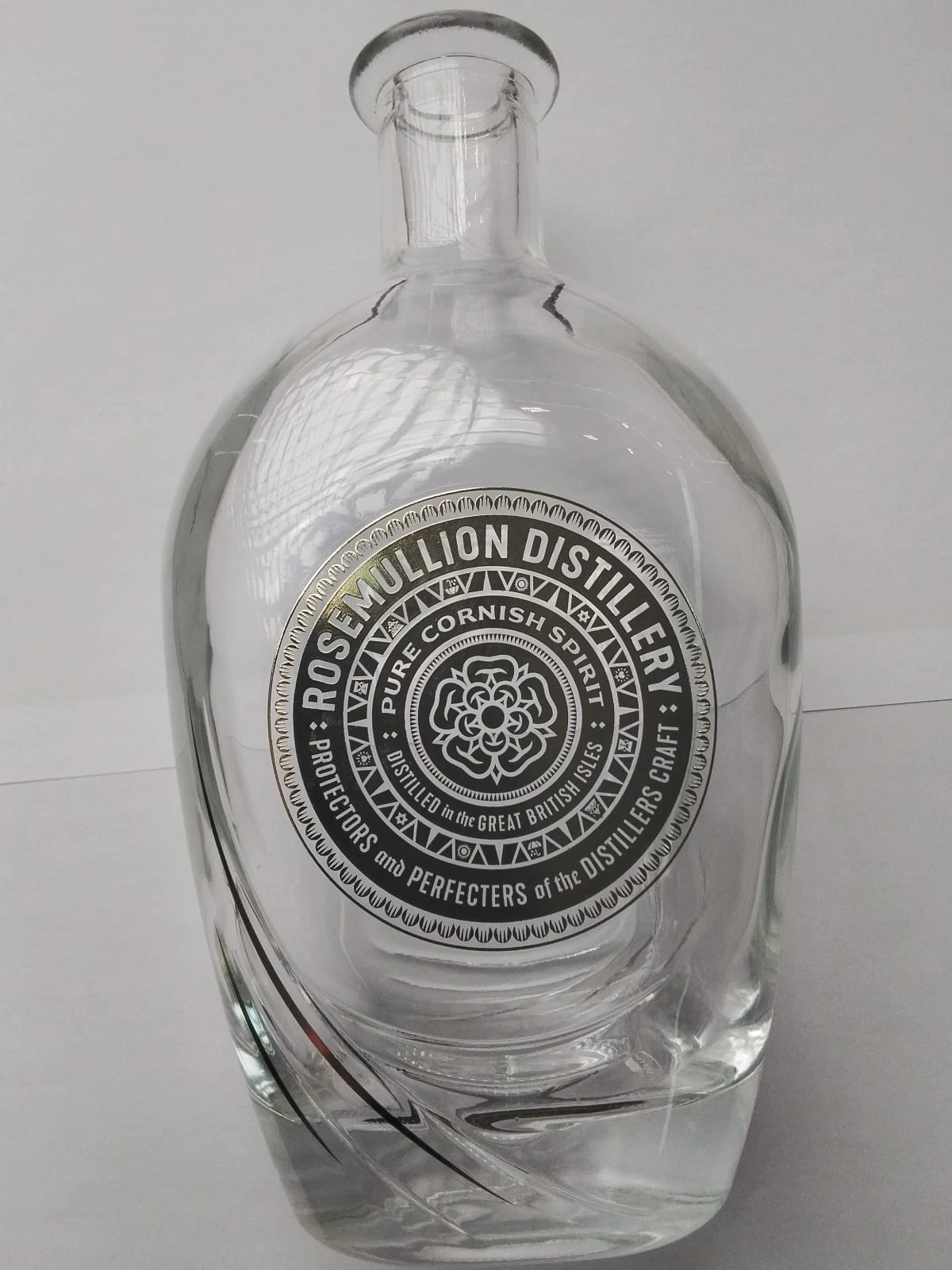
Real Case Study – Premium Gin Bottle for UK Distillery (Cornwall)
Client profile:
Independent gin producer based in Cornwall, UK, supplying duty-free shops globally.
Project requirements:
- Fully custom heavy glass bottle
- Deep relief logo embossing
- Screen printing with metallic finish
- High consistency across global distribution
Challenges encountered:
- Initial mold wall thickness imbalance
- Print alignment shift on curved surface
- Weight variance exceeding tolerance
Amanda International Group coordinated:
- Mold drawing revision before final approval
- On-site sampling supervision in Ningbo
- Mid-production QC inspection
- Decoration consistency control
Final production volume:
4 full containers.
Result:
- Stable weight tolerance
- Consistent embossing depth
- Print alignment within agreed parameters
- On-time shipment
Project timeline:
Approximately 4.5 months from artwork to final shipment.
Full Project Timeline (Typical 2026 Scenario)
| Phase | Estimated Duration |
| Artwork approval | 7–15 days |
| Mold development | 25–40 days |
| Sampling | 7–12 days |
| Mass production | 30–45 days |
| Shipping to UK | 30–35 days |
Total cycle:
3–5 months depending on complexity.
Most Common Importer Mistakes
- Rushing mold approval
- Ignoring dimensional tolerances
- Skipping mid-production QC
- Assuming factory understands final market requirements
- Focusing only on unit price
Premium bottle manufacturing requires technical supervision, not only price negotiation.
When Is a Local Sourcing Partner Essential?
A sourcing partner becomes critical when:
- Mold investment is significant
- Premium branding is involved
- Decoration consistency is crucial
- Tight deadlines must be respected
- Multiple factories are compared
Continuity between artwork coordination, sampling and QC dramatically reduces risk.
Amanda International Group operates directly in Ningbo and coordinates the entire technical process from artwork validation to shipment.
FAQ – Custom Glass Bottle Manufacturing in China
What is the minimum order quantity for custom glass bottles?
For new molds, typically 30,000–50,000 pcs. Existing molds may allow lower MOQ.
How much does a custom glass bottle mold cost?
Usually between USD 3,000–10,000 depending on complexity and weight.
How long does production take?
From concept to shipment, 3–5 months is realistic for custom bottles.
Can I order small quantities?
Small quantities are possible only if using existing molds. Fully custom molds require higher MOQ.
How do I ensure consistent screen printing quality?
Through technical artwork preparation, sampling validation and mid-production quality inspections.
Final Thoughts
Custom glass bottle manufacturing in Ningbo offers strong cost advantages and high technical capability.
However, success depends on:
- Structured engineering approach
- Proper mold validation
- Controlled sampling process
- Consistent quality inspection
Premium packaging requires continuity and technical supervision.
If you are planning a custom glass bottle project and want a technical feasibility evaluation before investing in molds, Amanda International Group can assist you from initial design validation to final shipment.